

Robot News Feeds: Separate Enclosures from Story Links
2026-11-02
Robot News Feeds: Separate Enclosures from Story Links
Enclosures describe an attached or related resource in feed formats, while a story link can serve a different reading purpose. A robotics editor who treats every address as another article can misdescribe what a feed contains. This practical lesson uses a fictional feed-reading plan. It downloads no media, inspects no live feed, and reports no new robotics announcement. The task is to identify a resource’s stated relationship before deciding how it belongs in an editorial workflow.
Identify the format and the entry being discussed
Start by asking which feed format the prepared material follows. Similar-looking addresses can occur in different structures, and their roles need the applicable format context. A learner should not infer the relationship from an address ending or from whether the resource sounds like a video.
Keep the entry’s description and its resources together during the exercise. Copying all addresses into one undifferentiated list discards the relationships the lesson needs to examine. The fictional example uses no publisher identity, actual headline, or media filename.
State the editorial question as well. Is the reader trying to locate the story, identify supplementary material, or understand the feed structure? These tasks may lead to different next steps. Ask the instructor to explain the planned treatment of related resources before any later collection is designed. Naming the task prevents an attachment from becoming a separate news item merely because it has its own address.
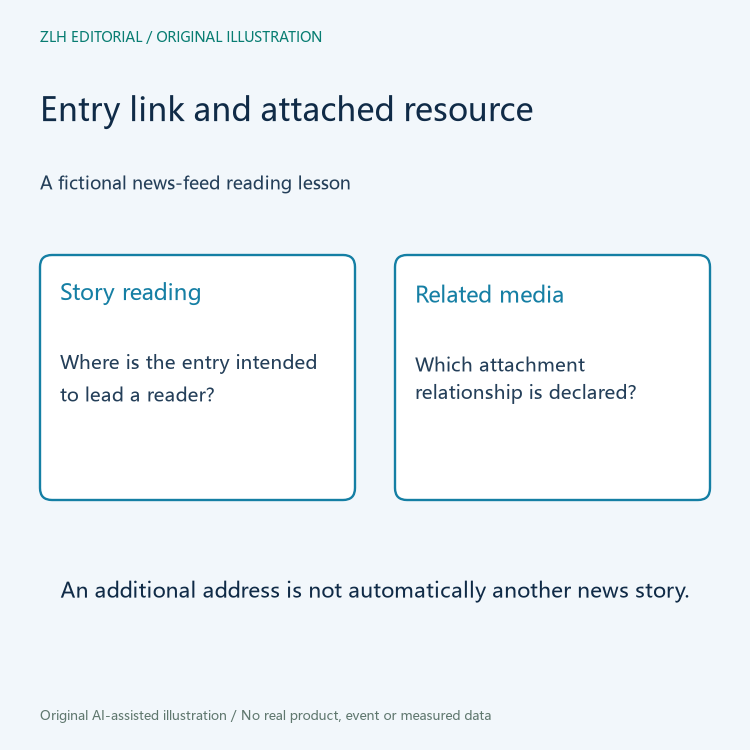
Read the RSS enclosure as an attached-media description
The RSS 2.0 specification describes enclosure as an item sub-element for an attached media object. It specifies attributes for location, byte length, and media type. These describe the enclosure’s representation in that format.
For an instructor-prepared entry, ask the learner which part identifies the attachment and which part identifies the story’s reading destination, if supplied. Do not assume the two roles are interchangeable. An attachment may be relevant to a story without constituting a second story.
The article supplies no actual lengths or types for a publisher’s resource. Documentation examples should not be copied into a new editorial record as if they were observed feed data. The exercise is about reading roles, not populating a pretend collection report.
Keep Atom’s relationship vocabulary in its own context
RFC 4287 defines the enclosure relationship for an Atom link as identifying a related resource that can be large and may need special handling. Its relationship vocabulary belongs to Atom’s link model. The learner should not simply rename an RSS element and assume every detail transfers.
Ask which relationship the prepared link declares and what the surrounding entry says. This keeps the format distinction visible while allowing the learner to compare the editorial roles. A resource can be related to an entry without its contents having been reviewed.
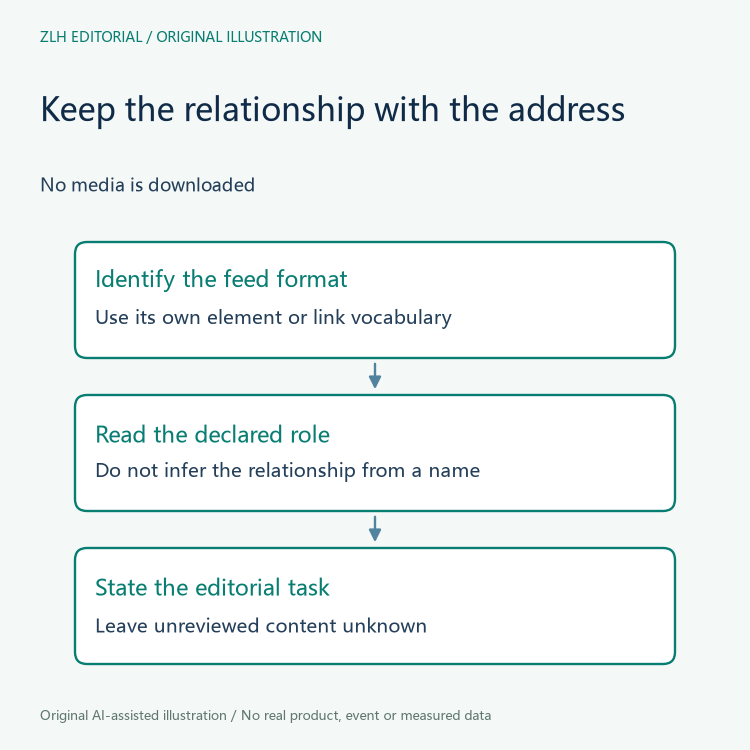
A link’s declared type is also not an observation of the actual representation returned by a future request. If a later authorized workflow retrieves material, it should examine that response in its own scope. This lesson makes no network request to an enclosure.
Decide the reading purpose before handling an attachment
An editor may only need to understand that supplementary media is offered. That does not require automatically downloading it as part of the conceptual exercise. A later workflow should define what resource is needed and why, rather than retrieve every address to make the collection look complete.
Keep any eventual media review separate from verification of the story’s claims. The existence of an attachment would not establish repeatable robot performance, the timing of an event, or endorsement by the publisher of every statement in the media. Those are different editorial questions.
The fictional class can leave a resource unexamined while still accurately describing its declared relationship. Unknown content should remain unknown. A precise note about what was not reviewed is more useful than a guessed summary based on a filename.
Summarize one entry without inventing another story
Ask a colleague to reconstruct the distinction between the entry, its reading link if present, and the attached or related resource. If the explanation counts each address as a separate announcement, return to the format relationships and the original editorial question.
A useful teaching note states the format, the declared role, and the resource content that remains unexamined. It does not claim a completed collection, a verified announcement, or a successful media download. The role reading is valuable even when a later review has not been performed.
Further discussion appears in our robotics news-reading section and the article directory. Both original illustrations contain no real feed entries, media bytes, publisher claims, or observed collection results.


