

Sereact and Teradyne: Read the Returns Handling Scope
2026-11-03
Sereact and Teradyne: Read the Returns Handling Scope
Returns handling is the application at the center of an October partnership announcement from Sereact and Teradyne Robotics. For a robotics news reader, its value is more specific than a broad claim that artificial intelligence is reaching warehouses. It identifies a combination of suppliers and a class of work that the companies want to address. Reading the announcement carefully means preserving that application context while distinguishing the parties' statements from evidence about any reader's own operation.
What the October announcement actually connects
The Universal Robots announcement, dated October 21, 2026, pairs Sereact's Cortex software with Universal Robots arms. It names returned fashion items and piece-picking among the applications. This provides a concrete description of the partnership's intended work, rather than an explanation of every activity that takes place between receiving a return and reselling an item.
Sereact's own announcement carries the same date and describes a related returns demonstration. These are useful primary statements from the participants. Their shared wording should not be counted as independent experimental confirmation. Reading both helps identify who is making the claim and what they are describing; it does not create a second set of test results.
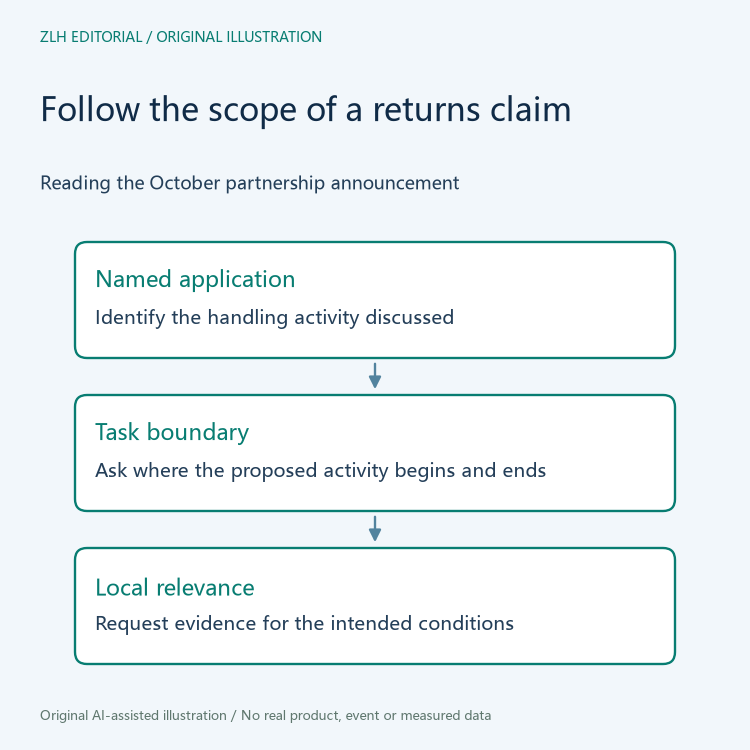
Give the task a beginning and an end
For editorial analysis, ask which part of returns handling the article is discussing. Is the subject the handling of an item presented to a robot, the movement of that item to another place, or the wider commercial process surrounding the return? A headline can compress these distinctions. A useful explanation restores them without silently expanding one robot task into an entire automated warehouse.
Imagine a reader considering whether the news is relevant to an existing returns operation. That reader could first describe the work they want to understand and identify its starting and ending conditions. This hypothetical exercise does not assert that the announced system supports every resulting requirement. It helps the reader formulate a clear question for a supplier instead of treating a broad application label as a complete specification.
Variation within the proposed task also deserves an explicit description. The local team can identify which items and conditions belong to its question and which remain outside it. The result is a more useful conversation about relevance. This publication has not inspected those items, observed a handling session or calculated a success rate, so none of those outcomes can be supplied here.
Read deployment statements as attributed claims
The participating companies discuss commercial deployment in their release. An editor can accurately attribute that statement while still asking what supporting material would be needed for a different question. Confirmation that a company reports a deployment is one conclusion. Determining the performance of that deployment under specified conditions is another. A news article should make clear which conclusion its available evidence supports.
For the same reason, avoid importing an unspecified performance number from a photograph or short event video. The image may show a robot in a particular arrangement, yet leave the timing, task boundaries and observation method unstated. A visual demonstration can introduce an application, but an editor should not infer a comparative result that the accompanying record does not establish.
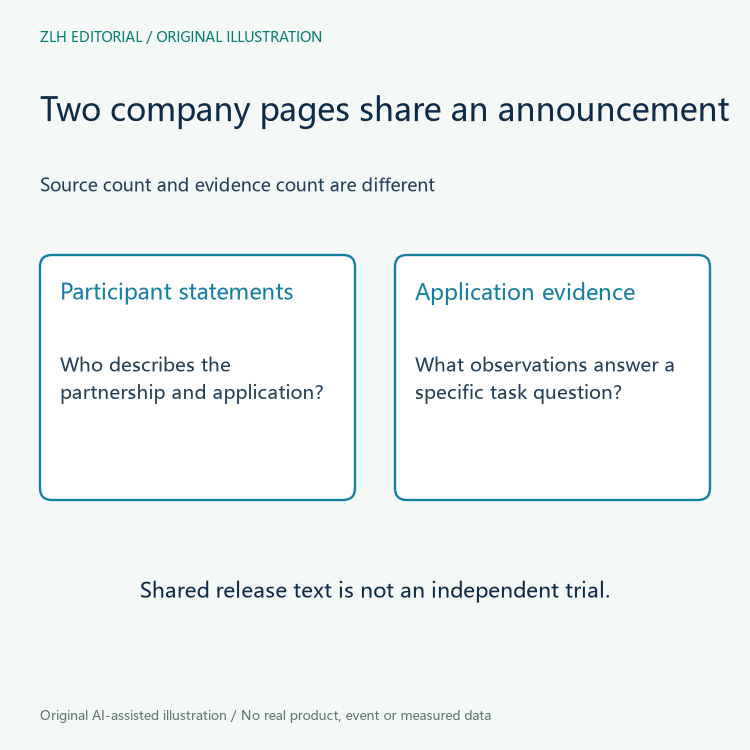
Keep partnership roles visible in follow-up questions
A reader asking about this application should know which participant can explain the software, which can explain the robot platform and who would describe an actual delivered system. The announcement connects these roles commercially. A specific project would still need its own explanation of responsibility and scope. This is a question for the parties, not a claim that this publication has negotiated a delivery arrangement.
Follow-up reporting can then focus on a bounded issue: which evidence would explain the proposed task under the reader's conditions? If later material becomes available, keep it attached to the relevant claim and state who supplied it. Do not retrospectively promote the original partnership text into a complete evaluation. New evidence should add a distinct, dated contribution to the story.
A more useful way to summarize this development
The October announcement is a specific collaboration around robot applications including returns handling. Its editorial significance lies in the supplier relationship and named work, rather than an invented claim that every return has become an autonomous process. This interpretation lets readers understand the news while retaining the questions that require actual application evidence.
Both illustrations are original editorial diagrams of claim scope. They contain no real warehouse layout, customer image or measured handling result. Readers can continue through the robotics news analysis collection or the article directory. Future updates should preserve the relationship between the task described, the party making each statement and any new evidence obtained, instead of repeating a broader headline with fewer qualifications.


