

Robot News Practice: Classify the Release Downloads
2026-11-03
Robot News Practice: Classify the Release Downloads
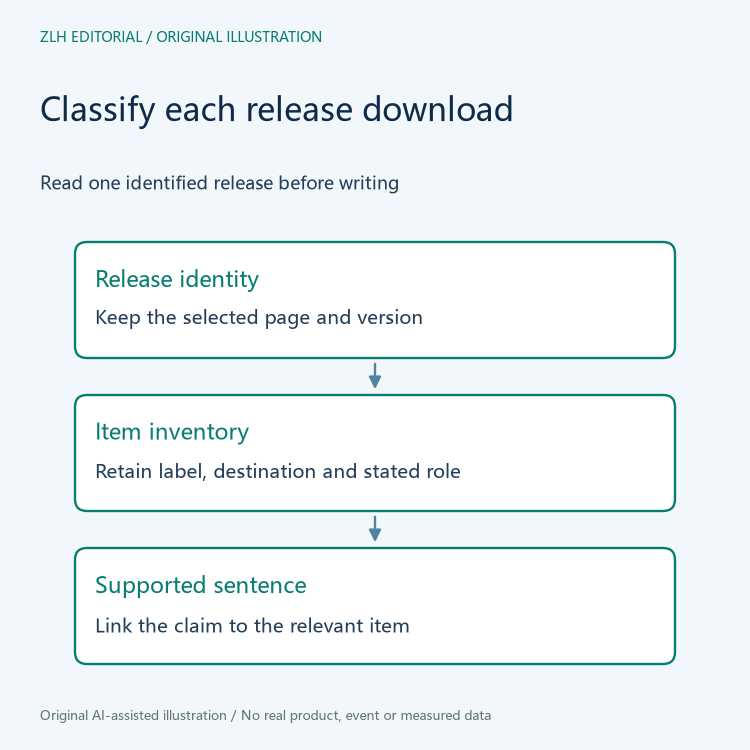
A robotics software announcement may point to a release page containing several download choices. An editor can accidentally describe a source archive as an installable application, or treat an attached file as the complete contents of the repository. Before writing the brief, build a small inventory of the release downloads and their stated purposes. This is a reading method for one identified release, not a report that any robot package has been downloaded or tested.
Identify the release rather than stopping at the repository
Record the repository owner, project name, release page and displayed release identity. Keep the announcement address as a separate source if it is on another page. The project home page may change as development proceeds; it does not by itself identify which release the announcement concerned. Avoid replacing a release-specific reference with a convenient link to the current default branch.
GitHub's release viewing documentation distinguishes navigating releases from navigating tags. Follow the relevant view and retain the selection in the editorial record. A tag listed in repository history should not be assumed to have the same explanatory material or attached files as a published release page.
Give each download its own inventory entry
Read the labels and release notes before categorizing the links. Preserve the exact file name, destination and stated role where these are supplied. Useful local categories might include a platform package, documentation attachment or source archive. These are editorial descriptions that must remain supported by the release material; a familiar extension alone is insufficient evidence of the intended use.
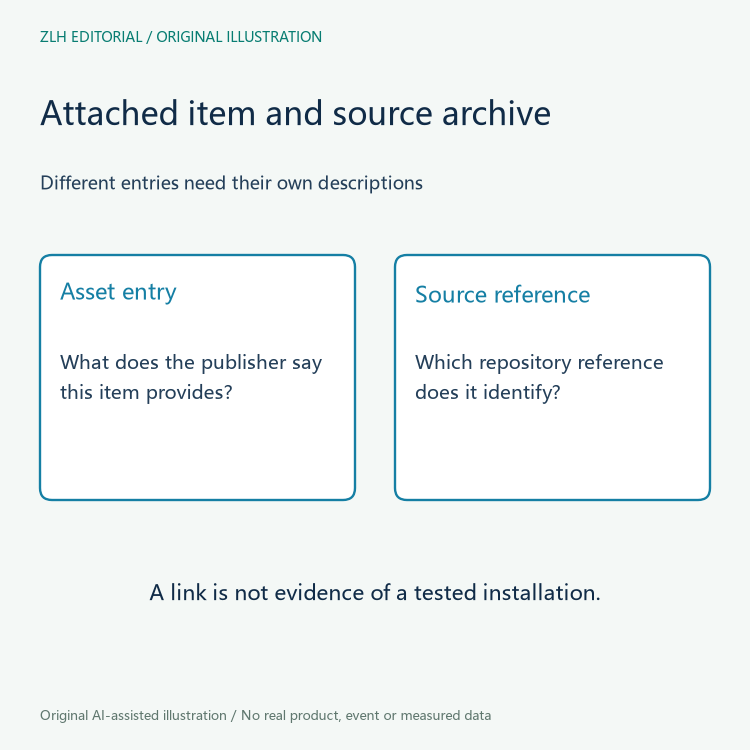
The official release API documentation shows assets separately from tarball_url and zipball_url in its release representation. That distinction provides a way to organize an inventory. It does not establish that every attached asset is a binary, that an archive builds successfully, or that two similarly named downloads contain equivalent material.
Trace the announcement's claim to the relevant item
Ask what the brief actually says the reader can obtain. If the announcement discusses a particular operating-system package, locate the release material that identifies that package. If it discusses access to source, identify the corresponding source reference. Do not let the presence of one category silently support a claim about another category.
Retain qualifiers such as architecture, edition or additional installation requirements only when the publisher states them for the selected item. A general project support statement may not describe every attachment. Missing information should become a specific question for the project maintainer or announcement author rather than an invented compatibility sentence in the news brief.
Likewise, a visible download link does not prove that a reader in every environment can retrieve or use it. A practical availability check would need its own observation time and outcome. Keep the page's declaration separate from any later authorized retrieval, and record an inaccessible item without claiming that the whole release has vanished.
Preserve changes without manufacturing a product event
On a later visit, compare the item inventory with the earlier observation. A changed file name, link target or release note can justify further reading, but the difference alone does not explain the reason for the change. The editor should identify what was actually observed and seek a publisher explanation where the meaning matters to the brief.
Never infer a hardware shipment, successful deployment or customer installation from the addition of a release attachment. Those are separate events requiring their own evidence. The inventory tracks what the release page offers and says; it is not a substitute for field reporting or a software acceptance record.
Write an attributed sentence with an explicit scope
Before publication, compare the proposed sentence with the selected item and its supporting note. The reader should be able to tell whether the story concerns published source, a named package or another attachment. If the distinction remains unresolved, narrow the statement or leave the item out rather than describing every link collectively as a ready-to-use robot download.
Keep the inventory with the brief's source record, including uncertain labels and later clarifications. Another editor should be able to reconstruct why a particular item supported the wording without repeating a download or guessing what the page looked like. A corrected classification can then update the affected sentence while preserving the earlier observation and reason for revision.
The two original diagrams illustrate classification and attribution without depicting an actual project release. Related reporting methods are in the verified robotics news collection and article directory. If an attachment has supplementary instructions, retain their relationship to that item instead of attaching the instructions indiscriminately to the entire release. A reader looking for a source archive may need a different explanation from a reader looking for a platform package. Review that association after a page revision, since a correct file name can remain visible while its explanatory context changes. A clear download inventory makes a small software announcement more useful while keeping untested assumptions out of its product claims.


